Massive crowds take to French streets to demand school fixes and police reform
Protesters across France gathered in their hundreds of thousands on Saturday to back student demands for better education facilities while criticizing the government's policing tactics.
By Anastasia Volkova ·
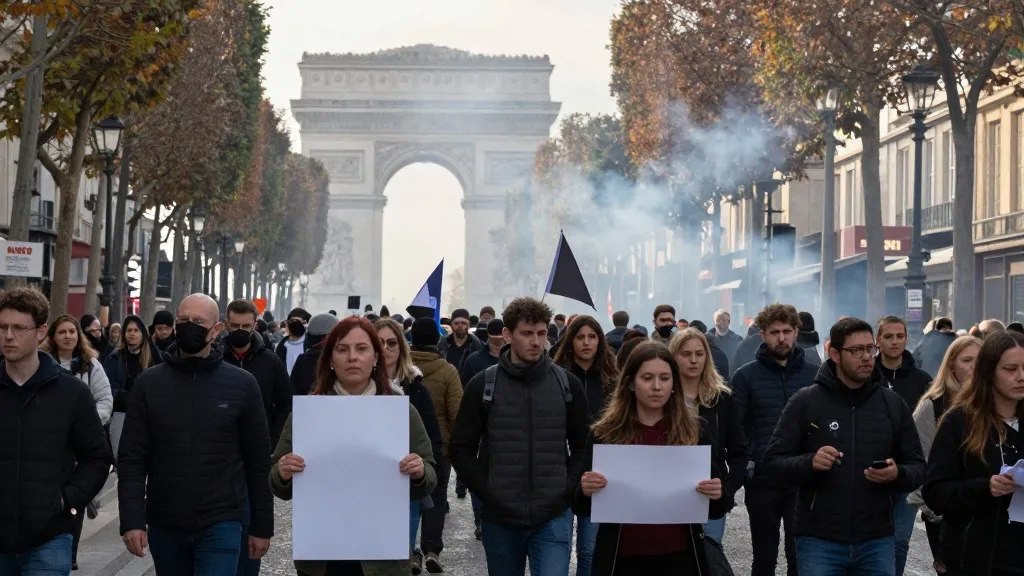
France witnessed a massive display of public dissent on Saturday as hundreds of thousands of citizens took to the streets in support of schoolchildren and to voice broader social grievances. The demonstrations unfolded in cities across the country, largely maintaining a peaceful tone despite the scale of the mobilization. This event marks a significant moment for President Emmanuel Macron, who faces a deepening political and social challenge during the final stretch of his current term.
In the capital, government estimates indicated that at least 110,000 people marched along the eastern perimeter of Paris. The crowd included high school students and their supporters, many of whom expressed frustration over the rising cost of living. A central theme of the protest was the perceived heavy-handed approach of law enforcement. Marchers argued that riot units were being deployed against school protesters rather than the government seeking political compromises. The atmosphere in much of the afternoon was festive, with brass bands performing and families participating alongside younger demonstrators. Banners carried by the crowd highlighted their stance on civil liberties, with slogans such as "Oppression breeds rebellion" and "The right to protest" clearly visible.
Tensions escalated as the Parisian march neared its conclusion at Porte de Vincennes. Groups of masked individuals dressed in black, who appeared separate from the main peaceful procession, threw glass bottles and stones at police lines. Officers responded with teargas, water cannons, and stun grenades. A trash bin was set on fire, and fireworks were launched toward the police. Similar scenes of friction were reported in other major cities. In Lyon, Lille, Montpellier, Nantes, and Toulouse, teargas was used to prevent protesters from entering city centers. In Marseille, clashes resulted in several bin fires.
The scale of the nationwide mobilization remains a subject of debate. The government calculated that at least 400,000 people participated, while trade unions claimed the figure was twice as high. Security preparations were extensive, with over 70,000 police officers deployed. Many shops boarded their windows, and several museums closed their doors. Authorities had braced for a repeat of the previous weekend, which saw some of the most violent unrest in years. That earlier protest, though largely peaceful in intent, resulted in public buildings being burned, hundreds of shops being destroyed or looted, and at least 2,700 arrests.
Protesters directed their anger at President Macron for banning non-union demonstrations that the government deemed illegitimate and for restricting access to city centers. Nadège, a 43-year-old communications worker who was teargassed during the previous weekend's events, returned to the streets to defend the legal right to protest. She noted that people are now afraid to demonstrate, making the act one of courage. A 21-year-old student from a blockaded science faculty in Paris described the current situation as an increasingly authoritarian regime attempting to suppress democratic rights in the street. The crisis originated in mid-September when students aged 15 to 18 began protesting staff shortages, crumbling infrastructure, and overcrowded classrooms. The movement has since grown into a major youth-led campaign involving trade unions, teachers, and parents. Police investigations are currently underway following reports that some children and protesters were injured by explosive police weaponry.
References to the 2018 and 2019 yellow vest movement were evident, with some demonstrators wearing the signature vests. Jérôme Rodrigues, a prominent figure from that earlier protest, stated that the government's fear was driving it to push demonstrators to the city's edges, away from centers of power. He predicted that demonstrations would continue every weekend. Pierre, a 60-year-old retired banking consultant, marched in support of his eight-year-old granddaughter, citing the government's refusal to listen. Jesse, a 40-year-old charity worker, described her careful preparation for the march, including wearing old clothes in anticipation of potential teargas or physical contact.
In Orléans, the protests took on a specific political dimension as thousands marched against a congress of the National Rally party, led by Marine Le Pen. The crowd, which included anti-fascist slogans, criticized both Le Pen, a frontrunner in next year's presidential election, and President Macron. Chants of "Macron, resign" and "Le Pen in prison" echoed through the city. Interior Minister Laurent Nunez reported that 135 people had been arrested nationwide. He also detailed the confiscation of various items, including metal balls, lead pellets, fireworks, slingshots, steel balls, improvised weapons, a katana sword, and airsoft weapons.
The coming weeks will likely see further testing of the government's ability to manage public unrest. With trade unions and student groups signaling their intent to keep the pressure on, the political landscape in France remains fluid. The administration must now balance its security objectives with the public's demand for dialogue, a task that becomes more complex as the presidential election year approaches.
Source: The Guardian